The Most Useful Fundraising Advice I Heard at DC Start Up & Tech Week
Melissa Bradley’s session was raw, direct, and easily the best one I attended that day. More importantly, it gave founders a real test for whether their business is ready to be funded.

Oct 28, 2026 · 8 min read
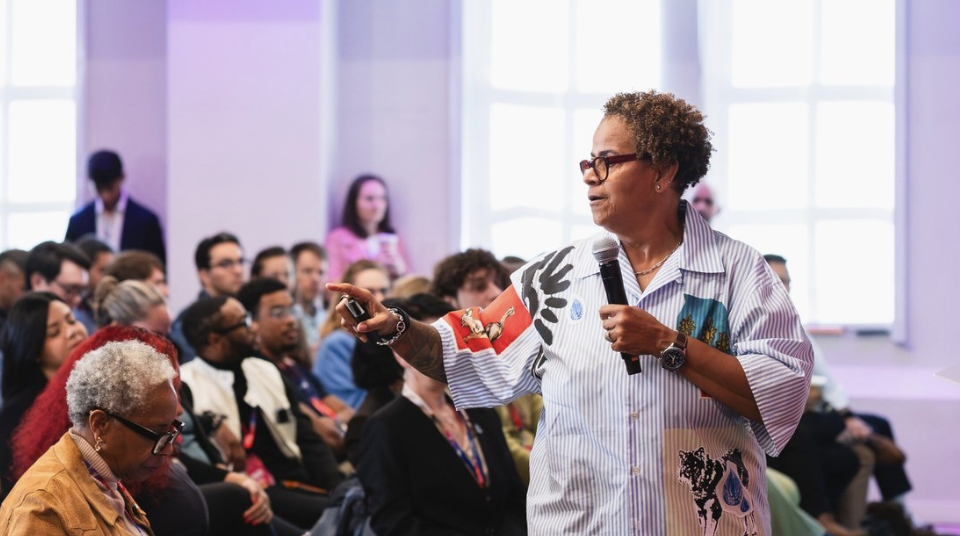
The best session I attended at DC Start Up & Tech Week was Melissa Bradley’s, largely because she did not dress the truth up for the room.
There was no fundraising theater. No vague motivational advice. No pretending that a beautiful deck, an AI label, or a big market-size slide can carry a founder through a hard investor conversation. She was raw about the actual standard: if the story, the economics, the team, and the ask do not hold together, investors will move on.
That honesty is what made the session so useful. A lot of startup advice makes entrepreneurship sound like an exercise in confidence and aesthetics. Melissa brought the conversation back to the work: understanding your customer, knowing your numbers, being honest about your own gaps, and making it easy for the right person to help you.
Her central message was one I think founders need to hear more often: fundraising is not a presentation problem. It is a business-readiness problem.
Yes, a strong deck matters. Clarity matters. Design matters. But no amount of polish can make up for a business that cannot explain who it serves, how it makes money, why the team can execute, what portion of the market is actually reachable, or what it needs from an investor.
That distinction is especially important right now. AI companies may get more meetings because investors do not want to miss the next breakout category-definer. Everyone else has to do more work to prove why their business deserves a place in a portfolio. But even for AI founders, novelty is not a substitute for a durable company.
Melissa framed the test around five things: the problem, the economics, the team, the market, and the ask. I left thinking these are not just investor checklist items. They are the operating disciplines that help founders build companies worth funding in the first place.
1. Be specific about the problem and the person who has it
Founders often describe a broad audience instead of a real customer. “We serve 18-to-24-year-olds” sounds like a target market, but it is only a demographic. It does not tell an investor why someone cares, what behavior already exists, what triggers a purchase, or why that person will choose you over an alternative.
The better question is: Who is this person when nobody is looking at a slide?
What does she value? What is already frustrating her? What does she spend money on? What does she do before she finds your product? What does she tell a friend when she describes the problem in her own words?
Melissa’s point was clear: investors do not need to personally have your problem. They need to believe that real people, outside of your immediate circle, experience it deeply enough to pay for a solution.
That is where founders need to move from vague demographics to lived psychographics. “People who follow creators, care about saving money, and regularly make purchase decisions based on social proof” is a more useful customer definition than “college students, 18 to 24.” One tells you how to build, market, and sell. The other mostly tells you how to buy an ad.
2. Know the difference between growth and scale
This was one of the most important distinctions from the session.
Growth is getting bigger. Scale is getting more efficient as you get bigger.
A company can grow revenue while still burning money inefficiently to acquire every new customer. That may look exciting in a pitch deck, but it does not automatically create a fundable business. Scale is when the economic engine begins to work: customer acquisition cost comes down, lifetime value increases, payback becomes faster, and the business can produce more output without expenses rising at the same rate.
In Melissa’s words, scale is “one in, three out.” It is the point at which the economics become meaningfully better, not simply the point at which the chart goes up and to the right.
Founders should be able to speak plainly about the numbers behind that story:
- How is revenue changing, and why?
- What does it cost to acquire a customer?
- How long does it take to earn that money back?
- What is the gross margin?
- What is the customer lifetime value relative to acquisition cost?
- How much runway is actually left?
You do not need to have a perfect business at the earliest stage. But you do need to show that you understand what is happening inside your business. “I need to ask my accountant” is not a credible answer to a question about the core mechanics of the company you are asking someone to fund.
The numbers are not there to make a deck feel more sophisticated. They validate the story.
3. Build a team that exposes your blind spots
There is a version of founder culture that treats doing everything yourself as a badge of honor. It is not. At a certain point, it is just a growth constraint.
Melissa’s advice was to start with a personal SWOT analysis: identify your strengths, weaknesses, opportunities, and threats. Then get honest about the work you should not be doing.
Not the work you dislike for a week. The work where you consistently lack the skill, judgment, energy, or desire to create an excellent outcome.
That is a powerful way to think about team-building because it moves the conversation beyond titles. The first hire is not automatically an assistant or a generalist. It may be an interim CFO, an interim CTO, an operator who can build systems, or an advisor with domain credibility that changes how customers and investors see the company.
The real goal is not to surround yourself with people who agree with you. It is to surround yourself with people who can challenge you, cover the gaps, and make the company stronger than your individual capacity.
Investors are also watching for commitment. If the financial model does not reflect founders and key contributors in any meaningful way, it raises questions about who is actually accountable for showing up every day. Even when cash compensation is deferred, the plan should make the team and its commitment visible.
4. Stop performing market-size theater
Every founder has seen the slide: a massive TAM, a smaller SAM, an even smaller SOM, and a claim that capturing just a few percentage points creates a billion-dollar business.
The problem is not that markets are unimportant. The problem is that those slides often become a substitute for a go-to-market strategy.
Melissa challenged founders to start with a person, not a giant number. Call her Samantha, Tiffany, or Tom. Explain the problem you solve for her. Explain why she will care now. Explain how you will reach her. Then show what portion of the market you can realistically earn.
That is a much stronger story than claiming five percent of a billion-dollar market before making your first sale.
Investors are not looking for founders to be small in their ambition. They are looking for founders who can connect ambition to a credible path. A market story has to answer more than “How big could this become?” It has to answer, “What can this team actually win, and how?”
5. Always make the ask actionable
Too many founders use a meeting, a pitch competition, or a networking event to explain their business and then leave without asking for anything.
That makes it hard for the person across the table to help.
The ask does not always have to be capital. It could be a relevant customer introduction, a pilot partner, a specific domain expert, feedback on a model, or an introduction to someone who understands a particular market. But it should be specific enough that the other person can respond in the room.
This is a simple practice, but it respects the reality of how investors and operators work. They have limited time, full inboxes, and many competing demands. If you create a clear action they can take immediately, you give the conversation a chance to become momentum instead of another forgotten follow-up.
The readiness test happens before the meeting
One of the most practical points from the session was that founder readiness is not just about getting to a yes. It is about avoiding a premature no that follows you into the next conversation.
Investors talk. Communities talk. In tight ecosystems, people compare notes. If your customer story changes from room to room, your financial ask does not match your model, or you show up without confidence in the business, that creates friction that is hard to undo.
Melissa described three common reasons investors pass:
-
They do not have enough context to understand why anyone wants the product.
-
There is a mismatch between the ask and what the numbers support.
-
The founder does not show up with enough clarity and confidence to make the business feel credible.
None of those are fixed traits. They are all work.
Before the next investor conversation, do the unglamorous preparation: complete the founder SWOT, identify your weakest capability, make sure the company story is consistent, pressure-test your financial model, and decide exactly what you need from the person in front of you.
If changing one assumption in the model does not flow through your three-year financials, the model is not ready. If you cannot explain where the customer comes from and why they return, the market story is not ready. If you do not know what you need from the meeting, the ask is not ready.
A great deck can earn attention. A defensible business is what earns conviction.
That is why Melissa’s session stood out to me. The rawness was not for shock value. It was a form of respect. She respected founders enough to tell them that capital is not an automatic validation, that entrepreneurship is not an automatic path to wealth, and that confidence without command of the business will not hold up for long.
The session did not make fundraising sound easy. It made the path clearer: do the work before the meeting, know what you need, and be ready to defend the business when the deck is no longer on the screen.
Founder & Editor
Founder of Vibe Connect. Writes about AI, risk, product and building community.